

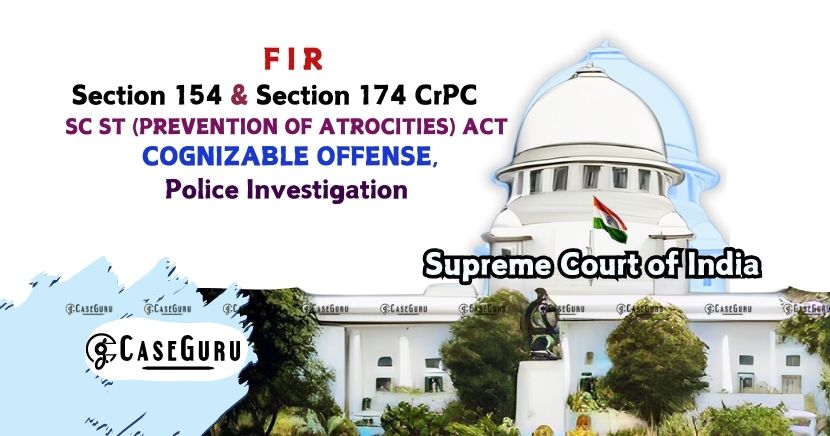
Supreme Court Mandates FIR Registration in IIT Student Suicides Alleging Caste Discrimination.
Supreme Court Directed the police to register FIRs based on the complaints alleging caste-based discrimination and foul play, The Apex Court also recognized the alarming trend of student suicides and constituted a National Task Force to address the mental health concerns of students and prevent such tragedies.
The present appeal arose from the dismissal of a writ petition by the Delhi High Court which was filed by the parents and brother of two late B.Tech students of IIT Delhi, who purportedly took their own lives in their hostel rooms. The appellants prayed for a writ of mandamus for the registration of FIRs and an exhaustive investigation into the deaths, contending that their sons/brother, being members of Scheduled Castes, were subjected to caste discrimination by staff and faculty, and their deaths were presented as suicides to cover up the true facts.
Despite the complaints filed by Ayush Ashna's father on July 21, 2023, and Anil Kumar's brother on September 9, 2023, describing incidents of caste discrimination and suspicious conditions leading to the death, police merely initiated investigations under Section 174 of the Code of Criminal Procedure (CrPC) and concluded that the students had died by suicide owing to depression.
The High Court, depending on the police investigation that located no confirmation of caste prejudice, refused to order registration of FIRs.
The Supreme Court, upon listening to the arguments, examined with rigor the applicability of Section 174 CrPC to police investigation into suicide and its divergence from the statutory method of FIR registration under Section 154 CrPC where a cognizable crime is revealed.
The Court laid stress on the fact that the object of Section 174 is confined to determining the apparent cause of death and cannot be equated with a complete investigation into cognizable offenses.
Relying on precedents like **Lalita Kumari vs State of UP ** (Click to Download), the Apex Court reiterated the statutory obligation of the police to file an FIR when information about the occurrence of a cognizable offense is received, without making a preliminary inquiry about the credibility or genuineness of the information. The Court observed that the complaints lodged by the appellants prima facie revealed the commission of cognizable offenses, such as abetment to suicide and offenses under the Scheduled Castes and the Scheduled Tribes (Prevention of Atrocities) Act, 1989, which under Section 18A of the Act, categorically prohibits any preliminary inquiry prior to the registration of an FIR.
The Court held the police's move to shut the case merely on a Section 174 inquiry without filing an FIR to be legally untenable. In its verdict, the Supreme Court granted leave in the appeal and ordered the Deputy Commissioner of Police (South-West District, New Delhi) to register FIRs on the basis of the complaints filed by the families of the deceased students and to depute a senior officer, not below the rank of Assistant Commissioner of Police, to conduct an in-depth investigation in accordance with the law.
The Apex Court, in acknowledging the spate of student suicides throughout the nation, especially in top-notch educational institutions, and observing circumstances like academic stress and discrimination based on caste, felt it was imperative to form a National Task Force to address the mental health issues of students and avert suicides in Higher Educational Institutions.
The Task Force, which consists of experts from different sectors and government representatives, was mandated to compile a detailed report which would determine the reasons behind student suicides, examine the current regulations, and provide recommendations for enhancing protections and an environment that is inclusive and accommodating in nature. The Court instructed the Task Force to provide an interim report within four months and considered the case as part-heard.
Coram: Justice J. B. Pardiwala and Justice R. Mahadevan
Between: AMIT KUMAR & ORS VS UNION OF INDIA & ORS 2025 INSC 384
Date of Judgment: 24-03-2025

Comments