

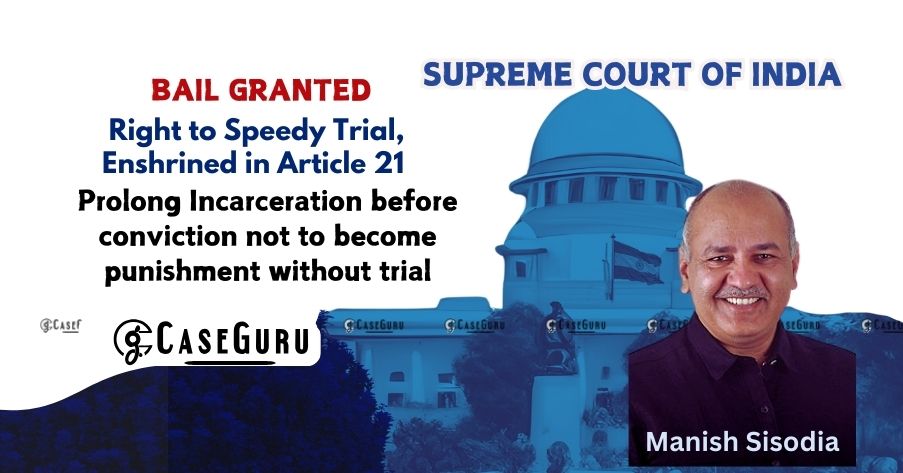
Bail is Rule, Jail is Exception: Held Supreme Court, and Overturns Delhi High Court and Trial Court's Decision, Grants Manish Sisodia Bail Description
Emphasizing the importance of the right to a speedy trial, enshrined in Article 21 of the Constitution, the Supreme Court granted bail to former Delhi Deputy Chief Minister Manish Sisodia, who was arrested 17 months prior, and stated that prolonged incarceration before conviction should not be permitted to become punishment without trial.
The Supreme Court of India, in a judgment delivered on August 9, 2024, granted bail to Manish Sisodia, the appellant in the case of Manish Sisodia v. Directorate of Enforcement. The case, involving allegations of irregularities in the 2021-22 Delhi Excise Policy, saw Sisodia facing charges from both the Central Bureau of Investigation (CBI) and the Enforcement Directorate (ED). The deputy chief minister of Delhi, Manish sisodia, is enlarged on bail today in both ED and CBI case. After having denied bail by the trail court and Delhi High Court, Manish appealed in the Supreme Court. It is pertinent to mentioned here that Manishi has been incarcirated for about 17 months.
Berief of the case:
It all started in the mid of 2022 where the allegations of irregularities in the Delhi Excise Policy surface, and The CBI registers its FIR against Manish Sisodia first which is followed by The Directorate of Enforcement. CBI arrested Mr Sisodia in Feb 2023 and the subsequent arrest by ED in March 2023 under the Prevention of Money Laundering (PMLA). However, the Central Bereau of Investigation charged him under Prevention of Corruption. Subsequently, Mr. Sisodia sought bail from trail courts in both ED and CBI but the bail was denied not even by the trail courts but also by the Delhi High Court which led him to file an appeal before the Supreme Court.
Key Observations made by the Supreme Court:
Right to Speedy Trial: The Court, highlighting that prolonged pre-trial detention, especially when the trial's conclusion seems distant, emphasized the prolonged incarceration endured by Sisodia, exceeding 17 months, without the trial even commencing. The Court highlighted the appellant's right to a speedy trial, stating that "keeping the appellant behind the bars for an unlimited period of time in the hope of speedy completion of trial would deprive his fundamental right to liberty under Article 21 of the Constitution." and further held "As observed time and again, the prolonged incarceration before being pronounced guilty of an offence should not be permitted to become punishment without trial."
Bail Not a Punishment: Referencing its earlier judgments, the Court reiterated the principle that bail should not be used as a punitive measure. The court acknowledged the seriousness of the allegations but stressed the fundamental principle that "bail is rule and jail is exception." It pointed out that the sheer volume of evidence in the case, including 493 witnesses and thousands of pages of documents, made it highly unlikely for the trial to conclude in the near future. The Court expressed concern that this principle "Bail is rule and jail is exception" is sometimes overlooked by trial courts and High Courts, leading to an overreliance on incarceration even in straightforward cases.
Section 45 of PMLA and Right to Bail: Addressing the stringent provisions of Section 45 of the Prevention of Money Laundering Act (PMLA), the Court asserted that the right to bail in cases of significant delay, coupled with prolonged incarceration, should be factored into the interpretation of both Section 439 of the Criminal Procedure Code (Cr.P.C.) and Section 45 of the PMLA. The Court emphasized that the constitutional mandate for a speedy trial holds paramount importance.
Delay in Trial: The Court rejected the respondent's contention that the appellant himself was responsible for delaying the trial proceedings. While the respondent alleged numerous applications filed by the appellant contributed to the delay, the Court found no evidence to support this claim. The Court noted that the appellant had filed a limited number of applications, primarily for accessing case documents, and that these applications were deemed reasonable and were granted by the trial court.
Factors Favoring Bail: The Court considered the appellant's deep roots in society and the fact that the case primarily relied on documentary evidence already in possession of the prosecution, mitigating the risks of fleeing or tampering with evidence.
Based on these observations, the Court allowed the appeals, quashed the High Court's order denying bail, and ordered the release of the appellant on bail subject to specific conditions. The conditions included furnishing bail bonds, surrendering his passport, regular reporting to the investigating officer, and refraining from influencing witnesses or tampering with evidence.
Concerns regarding potential evidence tampering were also addressed, with the court noting that the case primarily relied on documentary evidence already in the prosecution's possession. The court mitigated the risk of witness influencing by imposing stringent conditions, including restricting Sisodia's movements and mandating regular reporting to the Investigating Officer.
Coram: Justice B.R. Gavai and Justice K. V. Vishwanathan.
Between: Manish Sisodia v. Directorate of Enforcement
DOJ: 09/08/2024


Comments