

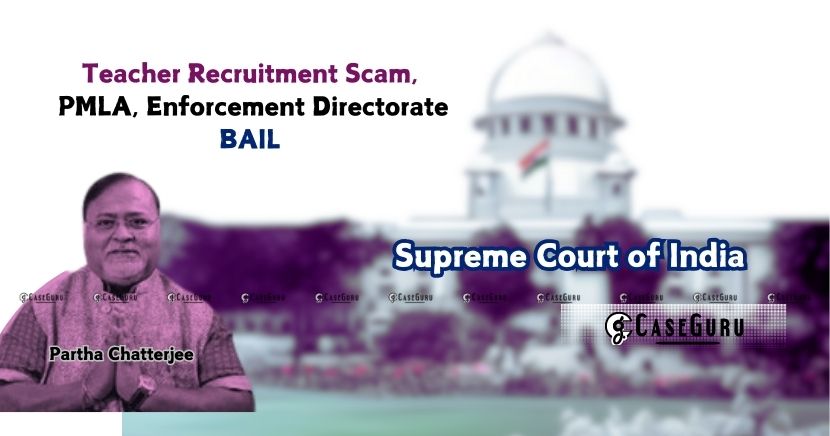
Citing Principle of Personal Liberty, The The Supreme Court grants bail to former West Bengal minister.
The Supreme Court grants bail to Partha Chatterjee, former West Bengal minister, in the high-profile teacher recruitment scam case, setting specific conditions and emphasizing the principle of personal liberty.
The Supreme Court granted bail to Partha Chatterjee, a former minister in the West Bengal State cabinet, in a case related to the illegal recruitment scam in the state's education department.
Background: Partha Chatterjee was education minister during 2016 when various educational, staff and other related recruitments took place and many writ peitions were filed before the High Court of Calcutta, questioning the process and serious allegations of corroupt practices. The High Court, in view of the serious allegations, directed the Central Bureau of Investigation CBI and to register the case.
Subsequently, the CBI registered cases under section 7, 7A and 8 of the Prevention of Corruption Act, 1988 (PC Act), as well as Sections 120B, 420, 467, 468, 471 and 34 IPC., which also led the Enforcement Directorate to register a case under Section 4 of the Prevention of Money Laundering Act, 2002. which eventually led the ED to search the close aides of Chatterjee's house and recovered heavry cash and gold jwelery and following the discovery of that substantial amount of cash and gold from properties linked to the appeallant chatterjee was arrested in July 2022 by the Enforcement Directorate (ED) under the Prevention of Money Laundering Act (PMLA).
The ED alleged that the money was the proceeds of crime generated from the illegal recruitment of teachers and other staff in the education department during Chatterjee's tenure as the state's education minister.
The High Court of Calcutta, previously denied Chatterjee's bail plea, upholding the twin conditions of Section 45 of the PMLA. However, the Supreme Court acknowledging the principle of personal liberty and the fact that Chatterjee has been incarcerated for over two years, granted him bail with specific conditions.
The Court recognized the principle that prolonged incarceration of an accused awaiting trial unjustly deprives them of their right to personal liberty. Statutory embargoes on the grant of bail must yield when weighed against the right to life and liberty under Article 21 of the Constitution. however, the official status of an accused should not be grounds for denying bail, it also cannot be a special consideration for granting bail.
The Court emphasized that the grant of bail must be determined based on the unique circumstances of each case, balanced against settled factors such as the gravity of the offense, the possibility of evidence tampering, and the risk of the accused absconding.
The Supreme Court took into account the societal harm caused by the alleged actions and the erosion of trust in public institutions and it considered the statement of Chatterjee's close associate, recorded under Section 50 of the PMLA, as prima facie evidence, but clarified that the question of its evidentiary value was not being addressed at this stage.
The Court also noted the apprehension of threat to life expressed by Chatterjee’s associate in the statement the Supreme Court thus, held the following:
The Trial Court is directed to decide on the framing of charges in the ED Case before the end of 2024 and the Trial Court will then record the statements of the most material witnesses in January 2025. Whereas, Chatterjee and his counsel are directed to fully cooperate with the Trial Court for the recording of witness statements.
Subsequently Chatterjee will be released on bail on February 1, 2025, subject to furnishing bail bonds, and if the examination of witnesses is completed earlier, Chatterjee may be released on bail immediately thereafter and Chatterjee shall not be appointed to any public office during the trial's pendency except for his membership in the West Bengal Legislative Assembly. Moreover, the Court held that any attempt by Chatterjee to influence or threaten witnesses will result in the cancellation of bail.
Coram: Justice Surya Kant and Justice Ujjal Bhuyan
Between: Partha Chatterjee vs Directorate of Enforcement
DOJ: 13-12-2024

Comments