

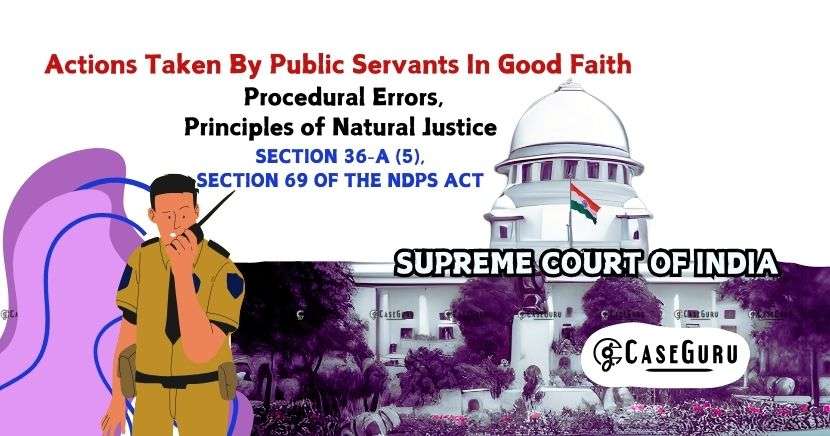
Citing Procedural Errors and Denial of Natural Justice, Supreme Court Acquitted Police Officer In NDPS Act
The Supreme Court of India acquitted a senior police officer from charges under the NDPS Act, highlighting procedural lapses, denial of natural justice, and the importance of good faith in law enforcement.
The Supreme Court of India acquitted Bharti Arora, a senior police officer, from charges under Section 58 of the Narcotic Drugs and Psychotropic Substances Act, 1985 (NDPS Act), stemming from her alleged involvement in a fabricated drug case against Ran Singh. The Court’s decision emphasized the importance of following due process of law, upholding principles of natural justice, and ensuring the protection of officers acting in good faith.
Bharti Arora was the Superintendent of Police (SP) in Kurukshetra, Haryana, from May 2004 to March 2005, and during her tenure, a drug case was registered against Ran Singh, who was found possessing 8.7 kg of opium. An inquiry was initiated the appeallant (Bharti Arora)when a Ran Singh claimed that he is innocent and that Opium had been planted by Surjeet Singh, Angrez Singh and Meha that Ran Singh was innocent and Surjeetm Angrez and Meha Deen planted drugs. The discharge petition was filed by the accused Ran Singh which got dismissed by the Special Judge and Subsequently the appeallan (Bharti Arora) was trasfered. The investigation was concluded and the final report under Section 173 CrPC revealed that the drug was infact planted by the trio. Subsequently Ran Singh was convicted but the trio were acquitted.
The learned Special Judge observed in the said judgment of conviction that the whole story of implicating Ran Singh by the trio was madeup by the senior police officers and a show cause notice was issued to the appeallant herein under section 58 of NDPS Act for initiating the proceeding. The appeallant challenged the show cause notice in the High Court of Punjab and Haryana, but it got dismissed.
The Supreme Court, however, identified multiple procedural errors in the trial court’s handling of the case against the appeallant and noted that the charges against Arora, under Section 58 of the NDPS Act, carried a maximum punishment of two years, necessitating a summary trial by a Magistrate as mandated by Section 36-A (5) of the NDPS Act.
The Special Court, which tried the original drug case, lacked the jurisdiction to conduct proceedings against Arora under Section 58, as this offense fell under the purview of a Magistrate and the Court determined that the Special Court did not adhere to the mandatory procedures for summons cases outlined in Chapter XX (Sections 251-256) of the Criminal Procedure Code, 1973 (CrPC).
The Supreme Court strongly condemned the trial court's actions, highlighting several instances where appeallant Arora's right to a fair hearing was violated. The trial court made adverse remarks and pronouncements against Arora without affording her the opportunity to be heard or present her defense, relying solely on arguments presented by the acquitted accused individuals.
On undue haste and predetermination the court observed that after the High Court dismissed Arora’s challenge to the show-cause notice, the trial court exhibited an undue haste in proceeding with the matter, scheduling hearings on seven dates within ten days despite Arora's documented commitments to urgent law and order situations.
The trial court's decision to dictate and seal the order even after receiving its transfer order and without Arora's presence reinforced the perception of bias and a predetermined outcome.
On protection of good faith, the Apex Court emphasized the significance of Section 69 of the NDPS Act, which grants immunity to government officers acting in good faith while performing their duties. The Court cited its previous judgment in General Officer Commanding, Rashtriya Rifles v. Central Bureau of Investigation and Another (Click to Download) (2012) to reiterate the presumption of good faith enjoyed by public servants unless proven otherwise.
The Supreme Court's decision in Bharti Arora vs The State Of Haryana serves as a powerful reminder of the fundamental principles that must guide legal proceedings. It underscores the critical importance of adhering to established legal procedures, respecting the right to a fair hearing, and ensuring that actions taken by public servants in good faith are not unfairly penalized.
Coram: Justice B. R. Gavai, Justice Prashant Kumar Misra and Justice K. V. Viswanathan.
Between: Bharti Arora vs The State Of Haryana
Date of Judgment: 13-12-2024

Comments