

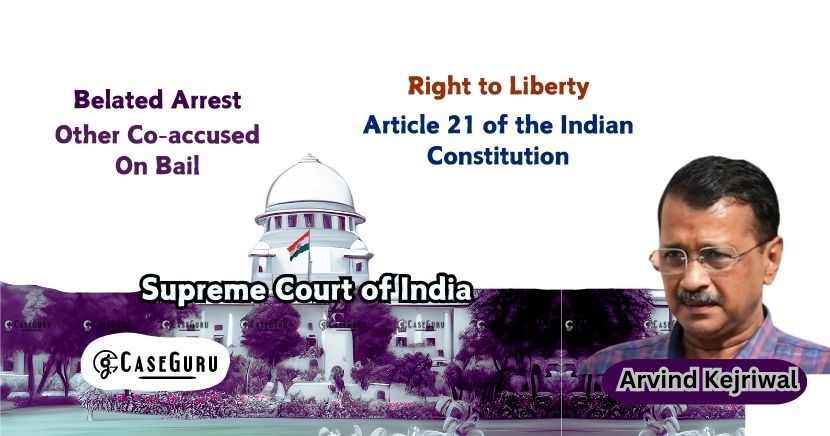
Delhi CM Arvind Kejriwal Released On Bail In CBI's Excise Policy Case
The Supreme Court of India has granted bail to Arvind Kejriwal in the Delhi Excise Policy corruption case, upholding the legality of his arrest but questioning the CBI's timing & belated arrest.
In a judgment issued on September 13, 2024, the Supreme Court of India, in a split decision, granted bail to Arvind Kejriwal, the Chief Minister of Delhi, in a corruption case related to the 2021-22 Delhi Excise Policy. The court upheld the legality of Kejriwal’s arrest by the Central Bureau of Investigation (CBI) but ruled that his continued detention was unjustified, considering he had already secured bail in a related case filed by the Enforcement Directorate (ED).
The central question of law before the Supreme Court was two-fold: first, whether the CBI's arrest of Kejriwal was illegal due to procedural violations of Sections 41(1)(b)(ii) and 41A of the Code of Criminal Procedure (CrPC), and secondly, whether the filing of a chargesheet constitutes a substantial change in circumstances warranting relegation to the trial court for regular bail.
Regarding the legality of the arrest, the court noted the following:
Compliance with Section 41A CrPC: While the CBI did not issue a formal notice to Kejriwal under Section 41A CrPC, which pertains to the requirement of notice when an individual’s arrest is not warranted, the court found that the CBI’s actions were compliant with the spirit and intent of the provision. Since Kejriwal was already in judicial custody related to the ED case, the court held that obtaining permission from the Trial Court for his interrogation, rather than issuing a formal notice through jail authorities, was sufficient to satisfy the essence of Section 41A.
Inapplicability of Section 41(1)(b)(ii) CrPC: The court determined that Section 41(1)(b)(ii) CrPC, which outlines conditions for arrest without a warrant, was not applicable in this case. This section, according to the court, ceases to apply when a Magistrate has issued an arrest warrant, as was the situation with Kejriwal.
Right to Liberty and Unjustified Detention: The court stressed the importance of an accused person's right to liberty and held that prolonged incarceration, especially when the trial's conclusion is not imminent, contradicts established legal principles and Article 21 of the Indian Constitution. The court considered that Kejriwal had already spent significant time in custody and the CBI case against him was not likely to conclude soon, making his continued detention unjustified.
Refrering to the case of Gudikanti Narasimhulu Vs. Public Prosecutor The Court held that "...bail is not to be withheld as a punishment."
Parity with Bail in ED Case: The court highlighted that Kejriwal had been granted bail in the related ED case, which involved a similar set of allegations but under stricter legal provisions. This, along with the fact that other co-accused in both the CBI and ED cases had been granted bail, weighed in favor of granting bail to Kejriwal.
Relegation to Trial Court: While acknowledging that the Trial Court is generally the appropriate forum for initial bail applications, the court decided against relegating Kejriwal to the Trial Court due to the advanced stage of the proceedings and in the interest of preventing further delays.
Dissenting Opinion on Arrest Timing: Justice Ujjal Bhuyan, while concurring with the decision to grant bail, expressed concerns over the timing of Kejriwal's arrest by the CBI. He noted that the CBI had not found it necessary to arrest Kejriwal for nearly two years, but acted only after he was granted bail in the ED case. This raised concerns about the CBI’s motives and cast a shadow on the necessity of the arrest and has held the following "41. That being the position and having regard to the discussions made above, I am of the unhesitant view that the belated arrest of the appellant by the CBI is unjustified and the continued incarceration of the appellant in the CBI case that followed such arrest has become untenable."
The Supreme Court's judgment underscores the delicate balance between ensuring a fair and just legal process and safeguarding the fundamental right to liberty. The split decision, with one judge expressing reservations about the CBI's actions, highlights the complexities of the case and the importance of judicial scrutiny in upholding the rule of law.
Coram: JUSTICE UJJAL BHUYAN, JUSTICE SURYA KANT.
Between: Arvind Kejriwal vs CBI, Arising out of Criminal Appeal No. 3816 / 2024.
Doj: 13-09-2024

Comments