

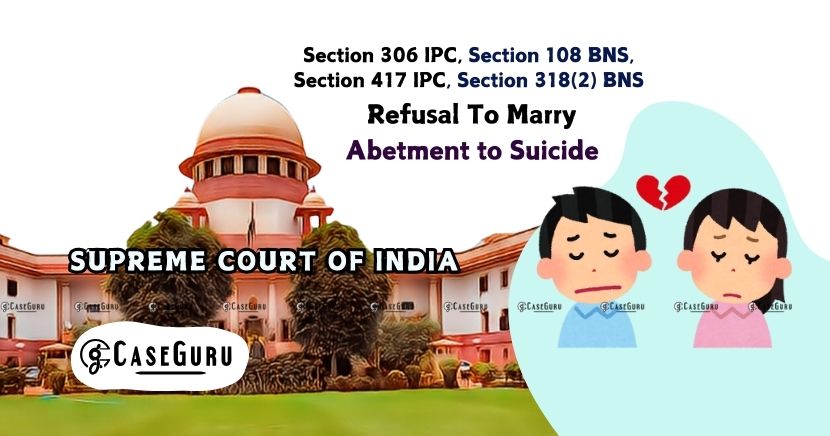
Refusal to Marry Does Not Constitute Abetment to Suicide: Supreme Court
The Supreme Court acquits a man convicted of abetment to suicide, holding that a mere refusal to marry does not meet the legal threshold for instigation unless continued course of conduct created such circumstances.
The Supreme Court in deciding the matter of Kamaruddin Dastagir Sanadi Vs State Of Karnataka identifies and explains the necessary ingredient constituting the offence under abetment to suicide under section 306 of the Indian Penal Code. The Apex Court overturned the impugned Order of the High Court of Karnataka that convicted the appellant, one Kamaruddin Dastagir Sanadi, for abetment to suicide and cheating; emphasizing that mere refusal to marry even on breaking a love relationship.
Background of the Case: The appellant, Kamaruddin Dastagir Sanadi, was accused of abetting the suicide of Suvarna, a young woman who had been in love with him for eight years, and Suvarna consumed poison and died after the appellant refused to marry her.
An FIR was filed by the mother of the deceased stating that the appellant had deceived her daughter with a false promise of marriage, which led her daughter to commit suicide in frustration.
The Trial court acquitted the appellant of all charges, including cheating (Section 417 IPC) and abetment to suicide (Section 306 IPC). However, The High Court, in an appeal filed by the State of Karnataka, convicted the appellant under Sections 417 and 306 IPC.
The Apex Court while citing its earlier judgements in Amalendu Pal alias Jhantu vs. State of West Bengal(Click to Download) and also in Prabhu vs. State represented by Inspector of Police & Anr(Click to Download) has held that "28. In Prabhu (supra) the Court further observed that broken relationships and heart breaks are part of everyday life and that breaking-up of the relationship would not constitute any instigation or abetment of suicide inasmuch as in order to constitute ‘Instigation’ it must be shown that the accused had by his acts and omissions or by continued course of conduct created such circumstances that the deceased was left with no other option except to commit suicide."
The Supreme Court emphasized the legal definition of abetment as provided in Section 107 IPC, which requires "instigation" or "intentionally aiding" a person in committing an act.
Instigation: The Court clarified that "instigation" involves provoking, inciting, or encouraging a person to commit an act9. A mere refusal to marry does not amount to such incitement.
Mens Rea: The Court stressed the requirement of mens rea (guilty intention) for the offense of abetment to suicide.
To establish abetment, the accused must have a clear intention to drive the deceased to suicide. This intention must be demonstrably linked to a positive act or direct act that led the deceased to believe suicide was the only option.
The Court referred to its previous judgments, including Ramesh Kumar vs. State of Chhattisgarh (2001)(Click to Download) and M. Mohan vs. State represented by the Deputy Superintendent of Police (2011)(Click to Download), to reiterate the principles governing abetment to suicide.
In Ramesh Kumar, the Court had held that words uttered in the heat of the moment, without the intention to incite suicide, do not constitute abetment.
In M. Mohan, the Court elucidated the elements of abetment, emphasizing the need for a clear mens rea and a direct act that led to the suicide.
Applying these principles to the present case, the Court observed that Suvarna was the one who pursued the appellant, traveling to his location and seeking him out.
The appellant's refusal to marry her was not a positive act intended to instigate suicide. However, there was no evidence to suggest that he provoked or encouraged her to take her own life. And the fact that Suvarna had brought poison with her, indicating a premeditated decision to commit suicide if the appellant refused her proposal.
The Court concluded that the appellant's refusal to marry, even if he had previously promised to do so, was merely a case of a broken relationship, which does not amount to abetment to suicide. Thus, the Apex Court allowed the appeal and acquitted the appellant of all charges.
The judgment clarifies the scope of Section 306 IPC and re-emphasizes the need for a high threshold of proof in abetment to suicide cases. It further underscores that a mere refusal to marry, even in the context of a broken romantic relationship, does not automatically constitute abetment to suicide.
The prosecution must establish beyond a reasonable doubt that the accused had the mens rea (guilty intention) and committed a positive act that directly instigated the suicide.
Coram: Justice Pankaj Mithal, Justice Ujjal Bhuyan.
Between: Kamaruddin Dastagir Sanadi Vs State Of Karnataka.
Date of Judgement: 29-11-2024

Comments