

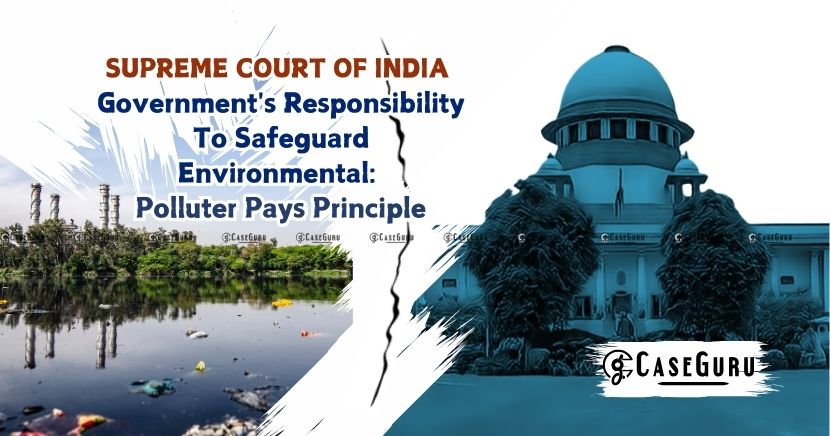
Supreme Court Addresses Vellore Tannery Pollution: Orders Compensation and Remediation
The Supreme Court directs compensation for pollution victims and remediation of environmental damage caused by tanneries in Vellore, emphasizing the Polluter Pays Principle and the government's duty to protect the environment.
The Supreme Court of India has underlined the government's responsibility to safeguard environmental interests in a case arising from PIL regarding unprecedented pollution caused by tanneries in Vellore District, Tamil Nadu, which had badly affected the environment, agriculture, and health of the people in the area.
Background: In 1991, the Vellore Citizens Welfare Forum filed a PIL before the Supreme Court to seek compensation for pollution victims and restore the ecological imbalance, and subsequenlty in 1996, the Supreme Court ordered the Central Government to form an authority to deal with the situation. Hence LoEA, or the Loss of Ecology (Prevention and Payment of Compensation) Authority "LoEA" came into being.
The LoEA worked out the ecological damage caused and identified the affected people and their entitlement to compensation. The awards were made in 2001 and 2009 but complaints persisted regarding the paying of compensation, continued pollution, and inadequacy of the remediation work.
In 2008, the Vellore District Environment Monitoring Committee filed a writ petition for increased compensation and for the implementation of the remediation schemes, however, the High Court dismissed the writ petition, and the said order is the subject of these appeals before the Supreme Court.
The Supreme Court observed that the basic tenets were made regarding the Public Trust Doctrine, Principle of Sustainable Development, and the Right to a Healthy Environment being the principles which should guide.
The Public Trust Doctrine: That the State holds in trust such resources that are basic to life for the public and has the duty to preserve them.
Sustainable development postulates a balanced development of socio-economic factors with the preservation of natural resources for generations to come.
Pollution by Tanneries: The court added that the tanning industry in Vellore District was a source of pollution that had degraded the Palar River and affected the livelihood of farmers and fishermen.
Polluter Pays Principle: The court referred to the "Polluter Pays" principle, whereby polluting industries are liable to pay compensation for the damage caused to the ecological environment and the people affected by such pollution, as well as the cost required for restoring the environment.
Continuing Liability: The court pointed out that the liability of polluters extends in these cases until the ecological damage is fully reversed.
Role of Government: It insisted that both the Central and State Governments, as also local authorities, are duty-bound to protect the environment, enforce environmental laws, and see that compliance ensues.
Need for Remediation: The court noted that no sufficient schemes were carried out to undo the ecological damage and that holistic measures were necessary to bring back the environment.
Importance of Periodical Assessments: The court emphasized that periodical environmental audits, monitoring of industrial emissions, and public disclosure of environmental data were required for transparency and accountability.
Rejection of Technical Objections: The court rejected the technical objections as to the method of sampling on the ground that such objections had not been raised before the LoEA.
Government Pay Principle: It applied the Government Pay Principle, ordering that compensation to the affected individual must be paid by the State government and it shall recover it from the polluters.
Thus, the Supreme Court passed the directions to the State government to pay compensation to all affected families/individuals, in case not already paid as per the awards passed in 2001 and 2009, and the state government was also asked to recover the amount of compensation from the polluters by law.
The State, in consultation with the Central Government, was directed to constitute a committee comprising a retired High Court Judge at its head to undertake an audit and to identify and maintain Vellore District in an environment which is clean and healthy.
Responsibilities Entrusted to Committee: The Committee has to scrutinise the claims for compensation, devise a scheme on holistic remediation, issue necessary directions to pollution control boards and also monitor industries.
The LoEA, as constituted now, shall periodically go through the situation and pass appropriate orders to ensure that the damage is reversed.
The State was directed to implement the suggestions made by the committee on formulating and executing schemes towards reversal of ecological damage.
The State was directed to conduct an environmental audit for each river, ascertain the level of pollution and publish the results.
The State was directed to issue appropriate directions regarding the mandatory installation of IoT-based sensors at the discharge points, incentivize the use of treated wastewater, and even consider providing an ethical and sustainability mark/tag for the industries.
The State government was also directed to ensure that the ban on illegal sand mining was implemented and a monitoring committee was established.
The court thus modified the impugned order of the High Court in WP Nos. 8335 of 2008 and 19017 of 2009 and dismissed the appeals filed by the Vellore District Environment Monitoring Committee, and confirmed the order of the High Court in WP No. 22683 of 2009 dismissing the appeal filed by the AISHTMA.
Coram: Justice J. B. Pardiwala Justice R. Mahadevan Between: Vellore District Environment Monitoring Committee Vs The District Collector, Vellore District & Others Date of Judgment: 30-01-2025



Comments