

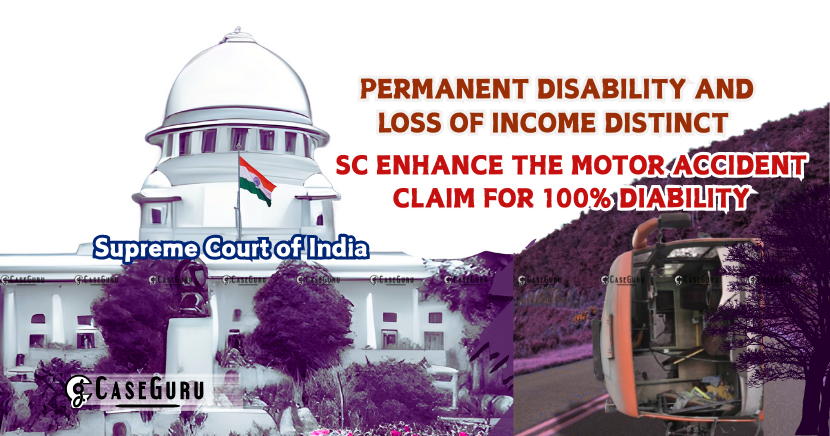
Supreme Court Enhances MACT Compensation; Permanent Disability and Loss of Income Distinct
Supreme Court of India significantly enhanced motor accident compensation awarded to a claimant suffering 100% permanent disability; clarifies principles under Section 166 of the Motor Vehicles Act, particularly regarding future medical expenses, attendant care, loss of enjoyment, family pain and suffering, and distinct heads for permanent disability and loss of income.
In a landmark decision, the Supreme Court of India in case of 'Kavin vs P. Sreemani Devi & Ors.' (2025 INSC 1028) significantly enhanced the compensation for a victim of a motor accident.
The appellant-claimant, Kavin, was a 21-year-old arts student when in the year 2011 the Omni bus he was travelling in, crashed due to the rash and negligent driving of the driver which resulted in his devastating 100% permanent disability and leaft him in a vegetative state. The Motor Accidents Claims Tribunal (MACT) originally awarded Rs. 67,83,866/-. However, when the appeal was prefered in HC, the Madras High Court reduced this amount by Rs. 19 lacs to Rs. 48,83,866/-, finding certain heads of compensation, such as future medical expenses and attendant charges, excessive, and entirely setting aside compensation for permanent disability, loss of enjoyment of life, and pain and suffering of family members.
Aggrieved by this reduction the appellant appealed before the Supreme Court. Noting that the High Court was not justified in reducing the quantum of compensation, particularly when the 100% permanent disability and vegetative state of the claimant were undisputed, the Apex Court made following observation:
Considering the claimant's young age (21 at the time of accident) and lifelong needs for the furture medical expenses, the High Court's reduction from Rs. 9 lacs to Rs. 2 lacs was found "totally unjustified" . Restricting expenses to only 25 years was deemed inadequate. For loss of enjoyment of life and amenities, the High Court had set aside the Rs. 3 lacs awarded by the Tribunal "without assigning any reason whatsoever". The Supreme Court found this unwarranted given the permanent disability and restored the Rs. 3 lacs. SC enhanced this head to Rs. 15 lacs.
Similarly, the High Court's reducing the attendant charges from Rs. 6 lacs to Rs. 3 lacs was considered insufficient by the Apex Court givent that the claimant's lifelong need for assistance, including a water bed and wheelchair, the Apex Court enhanced this to a lumpsum of Rs. 10 lacs. Crucially, the High Court had set aside the Rs. 3 lacs granted for permanent disability by stating that compensation for loss of income had already been granted. The Supreme Court emphatically stated that loss of future income and compensation for permanent disability are distinct heads, and the High Court's approach was "without any basis whatsoever". Considering the 100% permanent disability and vegetative state, the Court enhanced this to Rs. 5 lacs.
In conclusion, the Supreme Court found the High Court's reductions "unsustainable" and set them aside. It ultimately held that the claimant was entitled to a total compensation of Rs. 82,83,866/- with 7.5% interest, ensuring a more just and comprehensive award reflective of his severe injuries and lifelong needs.
Coram: Justice N. V. Anjaria & Justice Atul S. Chandurkar.

Comments