

Supreme Court Holds Criminal Proceedings Are Not To Be Instituted To Seek Revenge Quashes Proceedings U/S 406 IPC & Sec 6 Of The D. P Act.
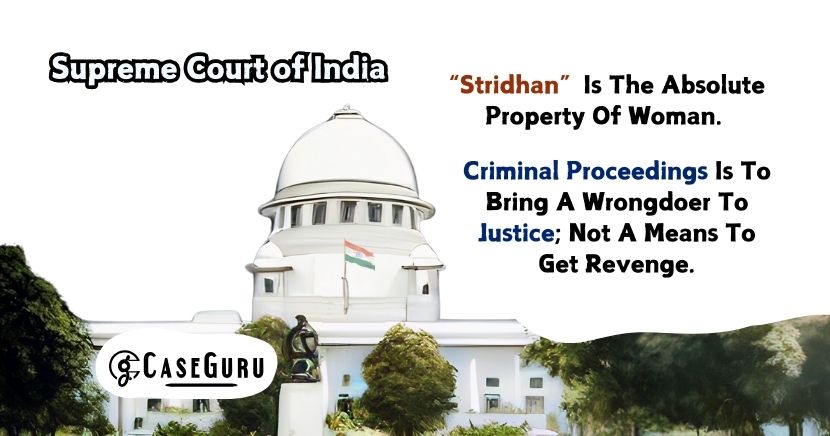
The Supreme Court In The Case U/S 406 IPC And Sec 6 Of D.P Act Held That The Criminal Proceedings Must Be Used To Bring The Wrongdoer To Justice And Should Not Be Used As A Means To Get Revenge.
The Supreme Court while allowing the Appeal in the matter Mulakala Malleshwara Rao & Anr V. State Of Telangana & Anr. has held that “the object of criminal proceedings is to bring a wrongdoer to justice, and it is not a means to get revenge or seek a vendetta against persons with whom the complainant may have a grudge”.
The appeal challenges the Telangana High Court's December 22, 2022, decision that denied quashing proceedings in C.C.No.1369 of 2022, related to charges u/s 406 IPC and u/s 6 of the Dowry Prohibition Act, 1961. The complaint, filed by Padala Veerabhadra Rao, concerns the alleged non-return of gold ornaments given as 'stridhan' to his daughter Padala Sujana Sheela Kumar's former in-laws at the time of her marriage in 1999. Following a 16-year marriage, the daughter divorced in the U.S. in 2016, settling all matrimonial issues and remarrying in 2018. In January 2021, Rao lodged FIR No. 32/2021 under Section 406 IPC for the return of these ornaments, which he claims were not returned despite repeated requests. Appellant No.1, Mulakala Malleshwara Rao, denied the allegations and sought to quash the charges under Section 482 Cr.P.C. after the investigation concluded and a final report was filed under Sections 406 IPC and 6 of the Dowry Prohibition Act.
The point of deliberation before the Division Bench was whether the complainant (father), had any locus to file the First Information Report which has led to the present proceedings keeping in view that the same was affected by delay and laches and whether the High Court was correct in refusing to exercise its inherent power in quashing the proceedings under the Cr.P.C.
The Court has observed while citing Pratibha Rani v. Suraj Kumar, that stridhan is the absolute property of woman given to her as per the Hindu rites during the marriage thereby quoting that “she is the absolute owner of such property and can deal with it in any manner she likes.”
The Supreme Court relying on the catena of judgements namely, Rashmi Kumar v. Mahesh Kumar Bhada, Maya Gopinathan v. Anoop S.B. has adhered to the settled position that “the jurisprudence as has been developed by this Court is unequivocal with respect to the singular right of the female (wife or former wife) as the case may be, being the sole owner of ‘stridhan’. It has been held that a husband has no right, and it has to then be necessarily concluded that a father too, has no right when the daughter is alive, well, and entirely capable of making decisions such as pursuing the cause of the recovery of her ‘stridhan’.
The Bench has observed that the complainant initiated action over 20 years after the marriage and five years post-divorce, despite the lack of authorization from his daughter to recover the ‘stridhan.’ Under Section 5 of the Power of Attorney Act, 1882, a person can grant authority to act on their behalf, but no such power of attorney was executed by the daughter in favor of the complainant.
The Court adjudicating on the power vested u/s 482 of Cr.P.C. stated that it is the settled law under State of Haryana v. Bhajan Lal whereby, the Supreme Court has laid guidelines for the exercise of power u/s 482 Cr.P.C. to quash criminal proceedings. The Court has remarked that the FIR u/s 406 IPC fails as the complainant has not provided evidence that the ‘stridhan’ was entrusted to the appellants or misappropriated by them. There is no proof of possession or conversion for personal use, and past cases like Bobbili Ramakrishna Raja Yadad v. State of Andhra Pradesh establish that dowry articles do not raise the presumption of being entrusted to in-law’s u/s 6 of the Dowry Prohibition Act. Additionally, the claim is undermined by a significant delay, being initiated more than 5 years post-divorce and 3 years after the daughter's second marriage.
The Supreme Court concluded that the FIR was lodged in 2021 despite the complainant’s daughter’s divorce in 2015 and subsequent remarriage in 2018, with no clear explanation for the delay. Given the existing Separation Agreement and lack of authorization from the daughter, the charge under Section 6 of the Dowry Prohibition Act is invalid. Therefore, the proceedings in CC No. 1369/2022 must be quashed as legally flawed.
Coram: J. K. Maheshwari and Sanjay Karol Case Details: Arising out of Special Leave Petition (Crl.) No.3981/2023 Between: Mulakala Malleshwara Rao & Anr V. State of Telangana & Anr. DOJ: 29.08.2024

Comments