

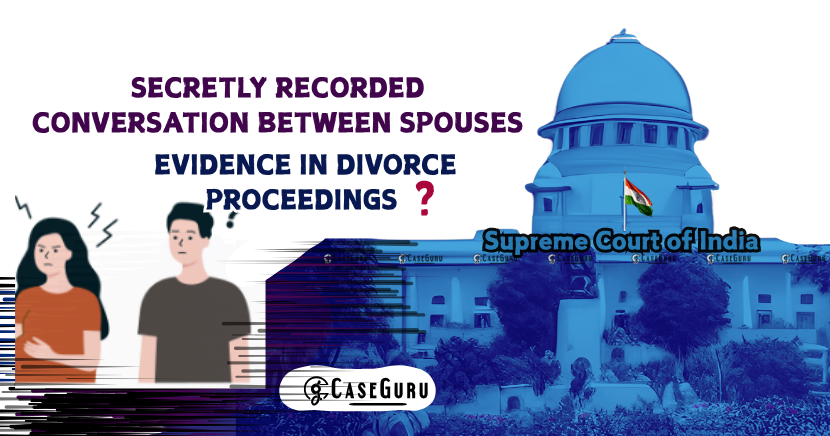
Supreme Court On Secretly Recorded Conversations Between Spouses As Evidence In Divorce Proceedings
This Supreme Court of India's judgment on the admissibility of evidence and overriding privacy objections. The judgment clarifies Section 122 of the Evidence Act, 1872, asserting its exception for inter-spousal litigation and rejecting the absolute right to privacy as a bar to relevant electronic evidence in such cases.
The Supreme Court of India set aside the judgment of the High Court of Punjab and Haryana and restoring the order of the Family Court. The judgement clarifies on the application of Section 122 of the Indian Evidence Act, 1872, and the right to privacy in matrimonial disputes.
Background: The appellant-husband, Vibhor Garg, filed a divorce petitioner against the respondent-wife, Neha, under Section 13 of the Hindu Marriage Act, 1955. During the proceedings before the Family Court, Bathinda, the appellant sought permission to submit a supplementary affidavit along with memory cards, a CD, and transcripts of telephonic conversations recorded between November-December 2010 and August-December 2016. The appellant argued these recordings were relevant to the adjudication of the divorce petition.
The respondent opposed this, citing that her examination-in-chief was complete and that the admissibility of such electronic instruments was in dispute, further claiming infringement of her right to privacy. However, the Family Court allowed the husband's application, deeming the conversations relevant and noting no bar on the admissibility of tape recordings, especially between the parties themselves. The reliance was made on Section 14 and Section 20 of the Family Courts Act, 1984, which permit it to receive evidence helpful in adjudication and have an overriding effect on general rules of evidence.
Agrieved by which, the respondent-wife filed a civil revision petition before the High Court of Punjab and Haryana against impugned order. The High Court held relying on various High Court judgments, held that recording conversations without the other partner's knowledge amounts to a violation of the right to privacy. The appellant then preferred a civil appeal before the Supreme Court.
Two primary questions that arose from this case;
1)Can the recordings of conversation be used as evidence under Indian Evidence Act, and
2)if the recordings can be admitted as evidence, does it not infringes the right to privacy of another partner?
Suprme Court Analysis: The Supreme Court reiterated its general principle and long-standing position that the mere fact that evidence was not obtained strictly in accordance with law does not absolutely bar its admissibility. While courts must tread with caution and ensure the accuracy and reliability of such evidence, it cannot be deemed irrelevant or inadmissible solely on the grounds of being illegally obtained. The Court referenced Yusufalli Esmail Nagree and R.M. Malkani, noting that a contemporaneous tape record of a relevant conversation is a relevant fact admissible under Section 7 or 8 of the Evidence Act, provided the conversation is relevant, voices are identified, and accuracy is proven by eliminating tampering.
• Interpretation of Section 122 of the Evidence Act (Section 128 of BSA) deals with "Communications during marriage," which are generally privileged, but it has two parts: 'compellability' (a spouse cannot be compelled to disclose) and 'permissibility' (a spouse cannot be permitted to disclose unless the other spouse consents).
◦Crucially, the Court emphasized the exceptions to the 'permissibility' part, which include "suits between married persons". The Court concluded that in a divorce proceeding, which is a suit between married persons, the bar on disclosure of privileged communication is lifted. Therefore, the wife's objection under Section 122 was unacceptable.
◦The Court clarified that the restriction under Section 122 does not apply to the communication between themselves to be put forth as evidence in any suit between the spuose, on contrary, the privilage against the disclosure by the spouse against another spouse disclosing what was told to them by the other spouse, but not what they told the other spouse or what was overheard by third parties.
On the role of Family Courts Act (Section 14) which gives wide discretion to Family Courts to go beyond strict rules of evidence for adjudication, the Supreme Court deemed it unnecessary to invoke this "extraordinary power" in the present case, as the Evidence Act itself provides the necessary exception under Section 122.
The Apex Court on Right to Privacy (Article 21) vs. Admissibility of Such Evidence against Spouse:
The Apex Court disagreed with the High Court's reasoning that secretly recorded conversations violate the right to privacy and observed that if a marriage has reached a stage where spouses are "snooping on each other," it signifies a "symptom of a broken relationship" and "lack of trust,", and snooping is an "effect and not a cause of marital disharmony".
Supreme Court further hled that the right to privacy is not absolute and must be read in light of the exception provided in Section 122 of the Evidence Act. Section 122 "does not recognise such a right at all" in this context; instead, it "carves out an exception to right to privacy between spouses" when they are in litigation against each other. While underscoring the historical rationale for Section 122's privilege, the Apex Court held that it was to protect the "sanctity of marriage" and "domestic confidence," not the individual's privacy in a broader sense. Therefore, in "suits between a couple (an exception provided for in Section 122 itself), the right to privacy is not a relevant consideration".
Thus, the Supreme Court set aside the High Court's order and directed the Family Court to admit the supplementary affidavit, memory card/chip, CD, and transcripts as evidence and consider them in accordance with law.
Coram: Justice B.V. Nagarathna and Justice Satish Chandra Sharma


Comments