

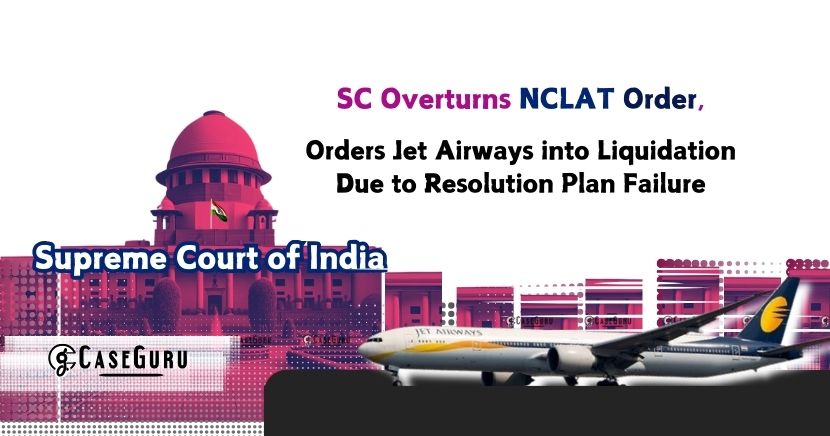
Supreme Court Overturns NCLAT Order, Orders Jet Airways into Liquidation Due to Resolution Plan Failure
The Supreme Court of India overturned the NCLAT's order and directed the liquidation of Jet Airways due to the Successful Resolution Applicant's inability to implement the approved plan.
The Supreme Court of India, in a significant judgment, overturned the order of the National Company Law Appellate Tribunal (NCLAT) and ordered the liquidation of Jet Airways (India) Limited (the "Corporate Debtor"). This decision stems from the failure of the Successful Resolution Applicant (SRA), a Consortium led by Mr. Murari Lal Jalan and Mr. Florian Fritsch, to implement the approved Resolution Plan despite multiple extensions and opportunities granted by various judicial forums.
The Court, presided over by a three-judge bench comprising Chief Justice Dr. Dhananjaya Y. Chandrachud, Justice J.B. Pardiwala, and Justice Manoj Misra, addressed several complex legal issues while examining the appeals filed by the State Bank of India and other lenders.
There were many legal questions considered by the Supreme Court:
Whether the Performance Bank Guarantee (PBG) furnished by the SRA could be adjusted against the first tranche payment of Rs. 350 crore, due within 180 days of the Effective Date?
-The Supreme Court ruled that adjusting the PBG against the first tranche payment was not permissible. The court determined that the Resolution Plan and the Lender's Affidavit both required a cash infusion (i.e., an actual payment of Rs. 350 crore), and the attempt by the SRA to adjust the PBG violated the terms of the plan.
Whether the Lender's Affidavit dated August 16, 2023, imposed conditions that differed from the terms of the approved Resolution Plan?
-The Court held that the Lender's Affidavit did not impose different conditions. It clarified that modifying an approved Resolution Plan is not permitted under Section 31(1) of the IBC, 2016, and both documents stipulated a cash infusion for the first tranche payment, thus aligning with the approved plan.
Whether the SRA's failure to pay workmen and employees dues as per the Resolution Plan and the NCLAT's order constituted a breach of the plan?
-The Court found that the SRA's failure to pay full Provident Fund and Gratuity dues, as ordered by the NCLAT, amounted to a breach of the Resolution Plan. The SRA's non-compliance violated statutory provisions under Section 30(2)(e) of the IBC, 2016.
Whether the NCLAT had sufficient grounds to conclude that non-compliance with the Supreme Court's directive to infuse Rs. 150 crore in cash did not warrant liquidation?
-The Supreme Court ruled that the NCLAT had erred in concluding that non-compliance with this directive did not justify liquidation. It clarified that the directive applied to both the Lender's Affidavit and the Resolution Plan, and the non-deposit of funds violated the plan, justifying liquidation under Section 33(3) of the IBC, 2016.
Whether the SRA had successfully fulfilled all the Conditions Precedent as stipulated in the Resolution Plan, particularly those relating to the Air Operator Certificate (AOC) and the allotment of slots?
-While the NCLT and NCLAT had found that the Conditions Precedent were met, the Supreme Court emphasized that the SRA's failure to implement the plan rendered these findings irrelevant. It reaffirmed that the Effective Date for implementation was frozen on May 20, 2022.
Whether timely implementation of the Resolution Plan is an objective of the IBC, 2016?
-The Court strongly affirmed that timely implementation is a critical objective of the IBC. It recognized that delays hinder the maximization of asset value and harm the interests of stakeholders, stressing that the power to extend timelines should be used judiciously.
The Supreme Court ruled that the NCLAT had erred in permitting the SRA to adjust the PBG against the first tranche payment, a decision that contradicted the Court's earlier order. It held that the term "infuse" in the Resolution Plan unambiguously meant "payment in cash" and that the SRA's failure to deposit the required amount constituted a material breach.
The Court further rejected the SRA's argument that the Lender's Affidavit imposed different conditions. It emphasized that once a Resolution Plan is approved, it is binding on all stakeholders, and modifications are impermissible under Section 31(1) of the IBC.
The SRA's failure to pay workmen's and employees' dues, despite clear directions from the NCLAT and the Supreme Court's confirmation, was found to be a violation of the Resolution Plan and statutory provisions. Regarding the Conditions Precedent, the Court reiterated that while these had been met, the subsequent failure to implement the plan rendered these findings irrelevant, with the Effective Date frozen as of May 20, 2022.
The Court also stressed the importance of timely implementation under the IBC, recognizing that prolonged delays can erode value and harm stakeholders.
In a bold move, the Court invoked its plenary powers under Article 142 of the Constitution and ordered the liquidation of Jet Airways, considering the exceptional circumstances. This decision highlights the Court's firm stance on ensuring compliance with approved Resolution Plans and its willingness to take extraordinary measures to prevent further abuse of the legal process.
This judgment serves as a stark reminder of the importance of adhering to the terms of an approved Resolution Plan and the need for timely implementation under the IBC. The Supreme Court's decision underscores the binding nature of such plans and signals the Court's commitment to safeguarding the integrity of the insolvency process.
Coram: CJI Dr. Dhananjaya Y. Chandrachud, Justice J.B. Pardiwala and Justice Manoj Misra.
Between: State Bank Of India & Ors Vs Jalan And Mr. Florian Fritsch & Anr.
Date of Judgment: 07-11-2024


Comments