


Supreme Court Quashes Cheating FIR in Commercial Dispute: No Dishonest Intention at Inception
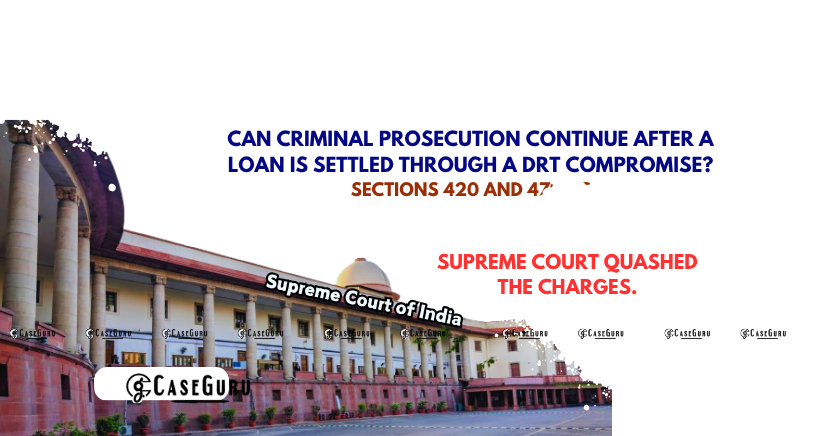
Supreme Court sets aside High Court order and quashes FIR under Section 420 IPC, holding that mere breach of contract in a business transaction does not amount to cheating absent proof of dishonest intention from the beginning.
This matter pertains to the dismissal of quash petition by the High Court of Judicature at Bombay at Nagpur. The FIR was registered at Police Station Lakadganj, Nagpur, under Section 420 of the Indian Penal Code, 1860 (IPC) on the complaint of Nitin, the second respondent, stating that the appellant, Manish, had portrayed himself as a well-known businessman and misled him into selling coal. Although preliminary payments were received, a major amount was due.
Later, a repayment agreement was signed before a Notary, but the appellant did not follow the payment schedule after depositing an initial amount, which led to FIR to be registered for cheating. The proceedings were refused to be quashed by the High Court, holding prima facie evidence of an offence under Section 415 IPC, specifically referring to the admission of the appellant in the notarized agreement regarding causing the sale by means of false representation.
Supreme Court examined whether the facts and evidence gathered revealed the commission of an offence against Section 420 IPC, and whether the appellant entertained a dishonest intention right from the beginning of the business transaction.
The Apex Court affirmed the doctrine that a commercial dispute may have criminal consequences, but the determinative test is whether the guilty party made a false representation right at the start of the transaction with the intention to cause the other party to part with property.
The Apex Court noted that the ongoing supply of coal by the second respondent even after violations of the credit limit reflected an ongoing business relationship. In addition, the Court noted that the financial position of the appellant was evidenced by bank statements reflecting large mortgaged properties and consistent repayment of loans up to 2016, with another loan approved in 2018.
The Supreme Court reaffirmed that mere non-fulfillment of a promise or a subsequent agreement does not necessarily imply dishonest intention in entering into the original contract.
The Court separated the instant case from those where there is a manifest act of fraud or misappropriation of funds. It believed that the High Court was wrong in holding dishonest intention on the sole basis of the violation of the subsequent agreement and ignoring the evidence that the appellant is a businessman of some means. The Apex Court referred to example (g) of Section 415 IPC, pointing out that a later breach of contract does not amount to cheating if there was an intention to perform the contract when it was entered into. The Court also referred to the rule that invoking criminal law to recover arrears arising out of losses in business is not acceptable.
The Supreme Court granted the appeal and set aside the proceeding having originated from FIR No. 80/2022. The Court was of the view that the evidence obtained in the course of the investigation did not prove that the appellant had acted with dishonest intention right from the beginning of the transaction when the coal was supplied.
The Court held that the reasoning of the High Court was faulty as a mere violation of a promise to repay was not necessarily suggestive of a dishonest intent to defraud. The Supreme Court held that the case was essentially a commercial dispute, and the ingredients of the offence under Section 420 IPC were not established.
CORAM: JUSTICE PAMIDIGHANTAM SRI NARASIMHA & JUSTICE JOYMALYA BAGCHI
BETWEEN: Manish Vs State of Maharashtra and Anr 2025 INSC 430
DOJ: 02-04-2025

Comments