

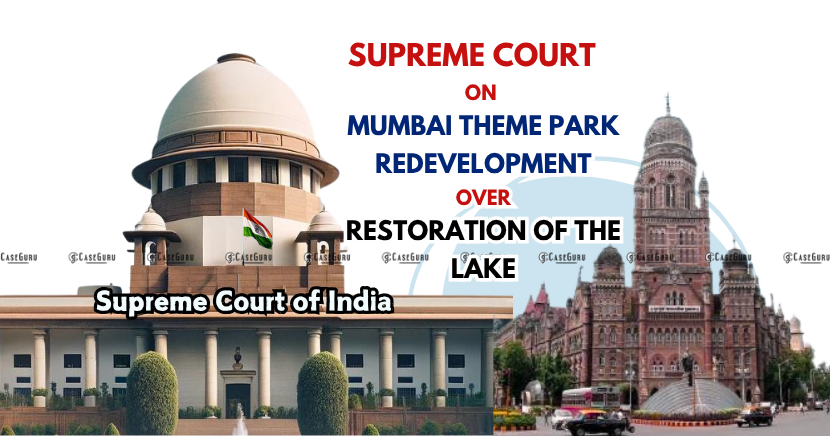
Supreme Court Upholds Mumbai Theme Park Redevelopment Over Lake Restoration
Supreme Court Overturns Bombay High Court Order on Mumbai Theme Park Redevelopment, Emphasizing Balancing Ecological Imperatives with Public Welfare and Evolved Ground Conditions.
Supreme Court heard the matter pertaining to the dispute over Municipal Corporation of Greater Mumbai's (MCGM) redevelopment of plot CTS No. 417 at Khajuria Tank Road, Kandivali (West), Mumbai, into a theme park, allegedly leading to the destruction of Khajuria Lake which was a 100-year-old water body used for Ganesh idol immersion.
In 2008, MCGM selected the site for a theme garden, claiming the lake was degraded and misused as a garbage dump. A tender was floated, and Ms. Techno Trade Impex India Pvt. Ltd. was appointed in April 2008. The project, approved in August 2009 with a ₹5 crore budget, proceeded despite the land belonging to the State Government. MCGM applied for an NOC in June 2009 but went ahead with the project, which was completed and inaugurated in December 2011.
A Times of India article in September 2012 highlighted the lake’s alleged filling, prompting Respondent No. 1 to file a Writ Petition seeking demolition and lake restoration. During that time, the Collector granted post facto sanction in February 2014, transferring the land to MCGM.
On August 3, 2018, the High Court allowed the petition, directing demolition and restoration. MCGM appealed to the Supreme Court, which stayed the judgment on November 16, 2018, allowing the park to remain.
The Supreme Court allowed MCGM’s appeal and set aside the High Court’s decision as it considered whether the park should be demolished to restore the lake or preserved the park due to its public utility and time lapse. The Apex Court stressed balancing environmental protection with development.
Supreme Court found the High Court’s interpretation as valid but overly rigid, calling for a more practical approach considering current conditions, due to "Public Trust Doctrine" and that it must align with sustainable development and public needs.
The Apex Court 3 Key Factors into consideration:
i. Prior Condition: The lake had lost its original form and use, serving mainly as a garbage dump. ii. Ecological Value of the Park: The park had matured with trees and facilities used by the community for 15 years. iii. Feasibility of Demolition: Demolition would cause environmental harm, waste public funds, and recreate an impractical, stagnant pond.
As on the "Post Facto Sanction" the Apex Court held that, though delayed, the Collector's approval secured the recreational use of the property and safeguarded it from future misuse, and that the petition was filed five years after the project began, after the park was completed and widely accepted by the public. The Court held that no public purpose would be served by reversing the transformation.
Accordingly, the Supreme Court directed that the park be preserved as a public green space and directed the Municipal Corporation of Greater Mumbai to form an Expert Committee within three months to explore alternate water body creation nearby. MCGM must also restore degraded water bodies within a year and submit compliance reports for three years, and further held that the State Government remains free to adopt additional environmental measures.
Coram: Justice Surya Kant, Justice Nongmeikapadam Kotiswar Singh.

Comments