

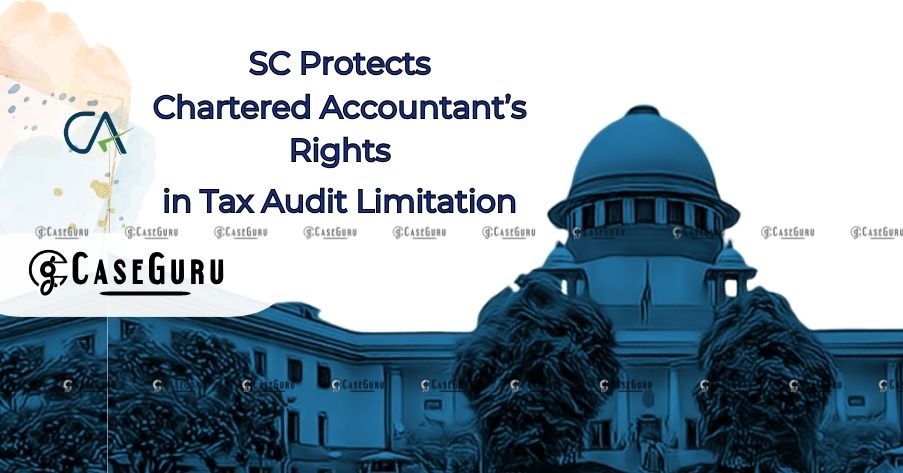
Supreme Court Protects Chartered Accountant's Rights in Tax Audit Limitation
In Landmark Ruling Clarifies Chartered Accountants' Right To Practice, Quashing Disciplinary Actions of Institute of Chartered Accountants of India (ICAI) Over Disputed Tax Audit Limitations.
The Indian Supreme Court ruled in favor of several Chartered Accountants challenging the Institute of Chartered Accountants of India (ICAI)'s imposition of a numerical limit on tax audits. The Court deemed the disciplinary proceedings initiated against these professionals for exceeding the limit as invalid, citing an "uncertainty in law" surrounding the guideline.
The case stemmed from the ICAI's 2008 guideline that restricted individual Chartered Accountants from accepting more than a specified number of tax audit assignments annually under Section 44AB of the Income Tax Act, 1961. This guideline aimed to ensure the quality of audits and prevent a monopoly of work. However, its implementation was inconsistent, leading to confusion and selective enforcement.
The Court recognized the ICAI's authority to regulate the profession and acknowledged the public interest in ensuring quality tax audits. It accepted the rationale behind limiting audits to prevent potential decline in quality due to excessive workload. However, the Court also emphasized the importance of balance, stating that while the ICAI holds the power to regulate, these regulations should not infringe upon the fundamental rights of Chartered Accountants to practice their profession.
While the Supreme Court ultimately upheld the ICAI's authority to set a limit on tax audits, the judgment included several key observations in favor of Chartered Accountants:
Right to Practice: The Court affirmed that Chartered Accountants have a fundamental right to practice their profession, derived from Article 19(1)(g) of the Constitution. This right, while not absolute, is subject to reasonable restrictions that must be justified in the interest of the general public.
Uncertainty in Law: The Court acknowledged the ambiguity and "uncertainty in law" that arose from the conflicting Madras High Court judgment and the ICAI's subsequent issuance of a new guideline. This uncertainty, the Court argued, created an unfair situation for Chartered Accountants who were left unsure about the legality of exceeding the tax audit limit.
Doubtful Penalisation: The Court invoked the principle against "doubtful penalisation," stating that individuals should not be penalized based on unclear legal provisions. This principle emphasizes fairness and transparency in the application of regulations, particularly those with punitive consequences.
Inconsistent Enforcement: The Court highlighted the ICAI's inconsistent enforcement of the guideline, noting that disciplinary actions were taken against only a subset of Chartered Accountants who had exceeded the limit. This selective enforcement, according to the Court, further amplified the uncertainty surrounding the guideline's validity and applicability.
Need for Review and Revision: Recognizing the evolving nature of the profession and advancements in technology, the Court directed the ICAI to review and potentially revise the specified limit on tax audits. This directive encourages the ICAI to ensure its regulations remain relevant, practical, and considerate of the current professional landscape.
These observations underscore the Court's concern for safeguarding the rights of professionals while acknowledging the ICAI's role in maintaining professional standards. The judgment emphasizes the need for clear, consistently enforced guidelines that balance the interests of the profession with the broader public good.
The Court highlighted the uncertainty stemming from a previous Madras High Court judgment that had quashed a similar guideline. While the ICAI had issued a new guideline during the pendency of an appeal against the Madras High Court decision, the Supreme Court noted that this created ambiguity for practicing Chartered Accountants.
Citing the principle against doubtful penalization the Court stated that individuals should not face penalties based on unclear legal provisions. It observed that the ICAI had not consistently enforced the guideline, choosing to pursue disciplinary action against some Chartered Accountants while overlooking others who had also exceeded the limit. This selective enforcement further contributed to the uncertainty surrounding the rule.
In light of these findings, the Supreme Court quashed the disciplinary proceedings against the petitioners, acknowledging the anxiety and professional detriment caused by the ambiguous legal environment.
The Court also directed the ICAI to review and potentially revise the specified limit of tax audits, considering factors like technological advancements and the current landscape of the profession. This directive encourages the ICAI to adapt its regulations to align with the evolving realities of the field.
Coram: Hon'ble Justice B.V. Nagarathna And Justice Augustine George Masih.
Arising out of Civil Original Jurisdiction, Transferred Case (Civil) No.29 Of 2021
Between: Shaji Poulose Vs Institute Of Chartered Accountants Of India & Others
Dated: May 17, 2024,
Click Here for Judgement Copy

Comments