

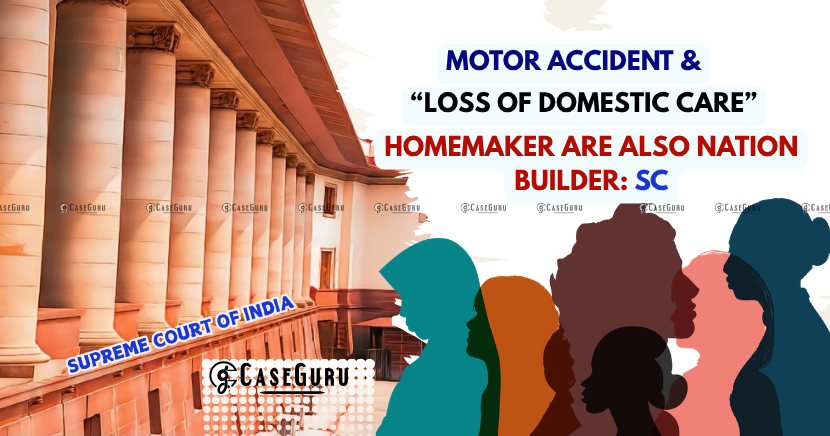
Supreme Court Recognizes Homemakers as Nation Builders in Motor Accident Case
The Supreme Court awarded ₹30,000 monthly under 'loss of domestic care' for deceased homemakers, ruling their unpaid contributions are vital to national development.
While hearing an appeal for on compensation calculated for the death of a homemaker in a motor accident claim, the Supreme Court allowed the appeal and enhanced the total compensation and held that describing a homemaker as a mere dependent is ironic.
The case stems from a tragic motor accident in year 2001, in which a homemaker lost her life due to rash and negligent driving of Respondent no.1. Her legal heirs sought compensation before the Motor Accident Claims Tribunal (MACT), Sirsa, which awarded ₹2,42,000 in December 2003. On appeal for enhancement, the High Court of Punjab & Haryana enhanced the compensation to ₹8,43,400 in December 2024—after a staggering pendency of twenty years, partly prolonged by a 2011 fire that destroyed court records.
Dissatisfied with the quantum and grieving the two-and-a-half-decade delay, the claimants appealed to the Supreme Court comprising a bench of Justice Sanjay Karol and Justice Nongmeikapam Kotiswar Singh. The Apex Court allowed the appeal and substantially enhanced the total compensation to ₹62,77,900.
The Apex Court held that a homemaker’s daily efforts form the foundational edifice of family productivity and national growth is undervaluated, and to remedy the historical disadvantage faced the Court introduced a new, stand-in head of compensation termed "Loss of Domestic Care" pegged at a basic minimum of ₹30,000 per month. Additionally, the Bench issued sweeping administrative directions across High Courts and MACTs to curb inordinate delays in motor accident litigation.
The Supreme Court further observed that describing a homemaker as a mere dependent is ironic when household functioning and economic productivity depend on her. Highlighting that women's unpaid domestic care accounts for 15–17% of India's GDP, the Bench declared that homemakers are "Nation Builders" whose invisible labor must be made visible.
The Apex Court recognized that standard non-pecuniary heads like loss of consortium focus strictly on emotional loss, and mandated adding a composite sum of ₹30,000 per month under the head of "Loss of Domestic Care".
This operates as a minimum stand-in monthly income where no conventional earnings exist, and applies in addition to income if the homemaker was part of the paid workforce. The base figure will increase by 10% cumulatively every three years.
Expressing deep concern over an average pendency of eight years in High Courts and six years in MACTs, the Bench observed that delayed adjudication compounds the grief of victims and denudes beneficial legislation. The Court directed that claim appeals pending over four years must be prioritized for listing by Chief Justices of High Courts.
The Apex Court set the compensation termed as "Loss of Domestic Care", pegged at a basic minimum of ₹30,000 per month and further urged the MACTs to routinely utilize summary procedures under Section 169 of the Motor Vehicles Act, 1988, requiring tribunals to formally record reasons if they choose not to adopt summary proceedings.
CORAM: JUSTICE SANJAY KAROL JUSTICE NONGMEIKAPAM KOTISWAR SINGH.



Comments