

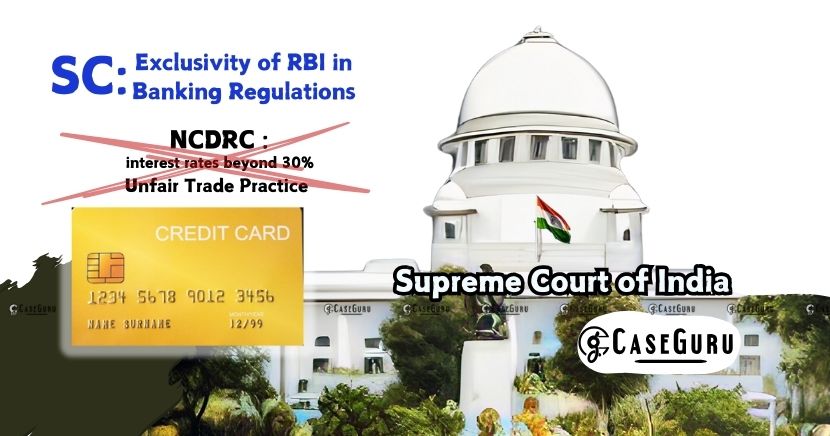
Supreme Court Upholds RBI's Authority Over Credit Card Interest Rates: A Blow to Consumer Challenges
The Supreme Court of India rules that setting interest rate ceilings for credit cards falls under the exclusive jurisdiction of the Reserve Bank of India (RBI), emphasizing the importance of regulatory expertise and the limited role of consumer courts in banking policy matters.
This landmark case, Hongkong And Shanghai Banking Corp. Ltd vs Awaz & Ors, decided by the Supreme Court of India in December 2024, tackles the contentious issue of credit card interest rates and the power struggle between consumer protection and banking regulations. The case had arisen out of a complaint filed by a consumer association, Awaz, against several major banks on the ground that the interest rates charged on credit card dues, which ranged from 36% to 49% per annum, was an unfair trade practice. The consumer association prayed for the intervention by the National Consumer Disputes Redressal Commission (NCDRC) with a view to impose a ceiling on credit card interest rates and to direct the banks to refund excess charges.
Where the NCDRC held in favour of favour of the consumer whereby it held that "..charging of interest at rates beyond 30% by the banks/non-banking financial institutions, from credit card holders, upon delay or default in payment, constitutes an unfair trade practice and that penal interest could be charged only once for one period of default and the same shall not be capitalized."
The consumer association (complainants) argued that the high interest rates charged by banks were exploitative and usurious, taking advantage of vulnerable credit card holders. They further contended that the absence of a specific interest rate cap by the RBI did not preclude the NCDRC from intervening to protect consumers from unfair trade practices.
However, the Banks (appellants) countered that setting interest rates fell under the exclusive domain of the RBI, the statutory authority responsible for regulating the banking sector, and that sections 21A and 35A of the Banking Regulation Act, 1949, which bar courts and tribunals from reopening transactions between banks and their customers based on interest rate disputes and empower the RBI to issue binding directives in the public interest. The banks further argued that their credit card interest rates were in line with RBI guidelines and market forces.
The Reserve Bank of India (RBI) as an intervenor in the case, strongly about its regulatory role regarding banking practices, including those relating to interest rates. It contended that the RBI circulars and master directions had given sufficient guidance to banks on the fixation of credit card interest rates and that it found no prima facie evidence of banks having contravened these directives. It further contended that the NCDRC had no jurisdiction to order policy matters for the RBI, a statutory body entrusted with specialized expertise in banking and finance.
The Supreme Court, after hearing both sides, gave its judgment in favor of the banks and the RBI by setting aside the order passed by the NCDRC. In the judgment by Justice Satish Chandra Sharma, the Court passed a detailed analysis, emphasizing the following:
The Supreme Court has categorically upheld the exclusivity of the RBI in banking regulation, including fixation of interest rates. It observed that the attempt on the part of NCDRC to try and impose ceilings on interest rates and ordering the RBI to issue specific regulations was an overreach and encroachment upon its statutory mandate.
The Apex Court has underlined the imperative of Section 21A of the Banking Regulation Act, 1949, to preclude the courts from examining the rates of interest per se received by banks in their dealings with their customers. The court explained that since the NCDRC was a consumer forum, it did not have the power to decide any questions pertaining to interest rates because it, too, was subject to this statutory bar.
On the regulatory expertise of the RBI, the Supreme Court recognized the sophistication of banking operations and required that decisions related to regulatory functions be left to institutions possessing specialist knowledge and expertise. The Court further observed that the NCDRC, as a consumer protection body, lacked experience and acumen in technical matters to arrive at an informed decision on banking policies on fixation of interest rates.
Importantly, the Court recognized that RBI circulars and master directions are binding and carry elaborate directions as to how banks would perform their functions, including credit card interest rates. It was observed that it is obligatory on the part of banks to follow these directions and that RBI had the power to take corrective action in case of any violation.
The Limited Role of Consumer Forums in Banking Matters: The Supreme Court explained that even as consumer forums play an important role in protecting consumers from unfair trade practices, their jurisdiction does not extend to challenging regulatory decisions made by expert bodies like the RBI. The court explained that consumer forums should restrict themselves to redressing individual consumer grievances and not attempt to lay down broad policy directives.
The Validity of Credit Card Contracts: The Supreme Court upheld the validity of the contracts between banks and credit card holders, noting that customers were made aware of the terms and conditions, including interest rates, before availing of the credit card facility. The Apex Court further observed that the NCDRC could not rewrite the terms of these contracts or impose new conditions on the parties.
The Supreme Court's judgment may have greater implications for the banking sector and consumer protection in India.
The Apex Court has reaffirmed the Regulatory Authority of RBI as the judgment places the RBI as the solitary authority to regulate interest rates and other banking practices. The Court also reiterates the doctrine of deference to regulatory expertise while advising judicial or quasi-judicial restraint in matters that are exclusively economic in nature.
The Apex Court limits the powers of 'Consumer Courts' and defines the jurisdictions of consumer courts, which gives one clear insight that the role of such Courts is to redress individual grievances but not to challenge overall wide regulatory decisions made by experts.
On the sanctity of contractual agreements, the judgment underlined that courts should not interfere with the terms of valid contracts unless they were demonstrably unfair, unconscionable, or against public policy. It has reaffirmed the role of specialized regulatory bodies like the RBI in making complex policy decisions and warned against judicial overreach into areas requiring technical expertise.
Coram:Justice Bela M. Trivedi and Justice Satish Chandra Sharma.
Between: Hongkong And Shanghai Banking Corp. Ltd vs Awaz & Ors.
Date of Judgment: 20-12-2024

Comments